

Dice Gun Commando Earns Indiepump’s Prestigious TOP CHOICE Badge
June 23, 2026
How to Optimize Your Steam Page for Maximum Wishlists
Your Steam page is the single most important marketing asset your game will ever have. Not your trailer on YouTube, not your TikTok account, not your Discord server. The store page is where a curious browser decides, in a matter of seconds, whether to wishlist your game or scroll past it forever.
Here is the uncomfortable truth most indie developers learn too late: the majority of games that struggle on Steam do not struggle because of a traffic problem. They struggle because their page does not convert. You can pour money and months into driving people to your page, but if that page does not turn visitors into wishlists, all of that effort leaks straight out the bottom.
This guide breaks down exactly how to build a Steam page that converts, element by element, using what actually moves the numbers in 2026. Let us turn your wishlists from a hope into a system.
1. Why Wishlists Are the Real Currency of a Steam Page and Launch Campaign
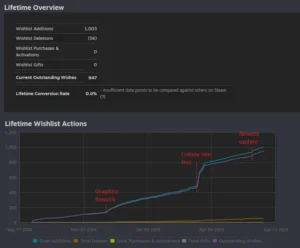
Wishlists are not a vanity metric. They are the closest thing Steam page gives you to a launch forecast, and they directly feed the machinery that decides how visible your game becomes.
Here is how the chain works. When your game launches, the players who wishlisted it get notified, and a strong burst of day-one sales is what signals to Steam that your game deserves attention. Steam’s own visibility documentation is clear that purchases and player engagement are the strongest signals the algorithm responds to. Wishlists are the fuel that produces those launch-day purchases, which in turn unlock the discovery surfaces (Popular Upcoming, the Discovery Queue, recommendation carousels, and More Like This) that bring in players you never paid to reach.
There is no official Valve-published wishlist threshold, but the pattern across countless indie post-mortems points in the same direction: aiming for somewhere north of 30,000 wishlists before launch gives you a real shot at climbing the visibility ladder. Plenty of strong games stall well below that, and the problem is rarely the budget. It is almost always page optimization.
Everything that follows exists to do one job: turn the people who land on your page into wishlists, and turn those wishlists into a launch that compounds.
2. Capsule Art: Your Single Highest-Leverage Asset
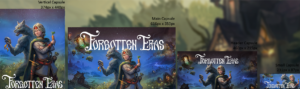
If you only fix one thing on your Steam page, fix your capsule. It is the image that appears everywhere players might encounter your game: search results, the Discovery Queue, recommendation rows, wishlists, and friends’ activity feeds. Every one of those surfaces shows your capsule, and if it does not instantly communicate what your game is, you have already lost the click.
The metric that matters here is click-through rate on the small capsule. Page-audit data across thousands of indie games points to a visibility cliff around 4% CTR. Above that line, Steam rewards you with more impressions, which compound over time. Most indie games sit below 2%. Closing that gap is the single highest-impact thing you can do in the month before launch.
Three rules that will get you most of the way there:
- Design for the smallest size first. Steam automatically generates a tiny 120 by 45 pixel thumbnail from your small capsule, and that is the size your art actually has to win. Pull your capsule up at that size: can you read the title and name the genre at a glance? If not, simplify until you can. Recognition beats originality at this stage.
- Use the current asset sizes. Since Valve’s August 2024 update, the four store capsules you upload are the Header (920 by 430), the Small (462 by 174), the Main (1232 by 706), and the Vertical (748 by 896). The older dimensions are no longer accepted, so check the current Steamworks templates before you brief your artist.
- Respect the asset rules. Base capsules may contain only your game’s artwork and its name. No review scores, no award laurels, no “On Sale Now” text. Breaking these rules can make your game ineligible for featuring in official Steam sales and events, which is a visibility death sentence. For temporary promotional text, use Steam’s Artwork Overrides system, which is built for exactly that and expires automatically.
One more thing worth knowing: a large and growing share of Steam browsing now happens on mobile, with some traffic reports putting it at 35% to 45% of visits. That makes small-capsule readability matter more than it ever has.
3. The Trailer: Your Five-Second Audition
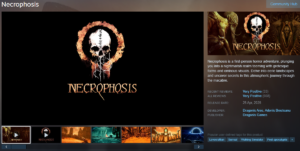
Steam auto-plays your first trailer the moment someone lands on your page, and it plays it muted. That single fact should reshape how you cut it. If your trailer depends on sound, narration, or a slow cinematic build to make sense, it will underperform.
Lead with gameplay in the first five seconds. Those opening seconds decide whether a visitor keeps watching or scrolls away, so cut the studio splash, the slow logo reveal, and the moody establishing shots. If your hook is, destructible environments, show something exploding on the first second. If your hook is tight combat, open on a clean parry into a counter. Show the fantasy, do not tease it.
On length, the sweet spot for most indie trailers sits between 45 and 75 seconds. Long enough to prove the game is real and varied, short enough that people actually finish watching.
4. Screenshots That Sell the Fantasy
Steam requires a minimum of five screenshots, but you should be showing eight to twelve, and every one of them should earn its place. The first few are what most visitors actually see, so lead with your strongest shot, never a collage of forgettable frames.
Aim for variety that tells a complete story about your game: core gameplay moments, a few different environments or biomes, your interface shown in real context, and at least one genuine “wow” moment that makes someone stop scrolling. Each screenshot should answer a different question a potential player might have, so that by the time they have scanned through them, they already understand what playing your game feels like.
5. The Short Description: Your One-Line Pitch
Your short description is the text that sits right under your trailer, and it is one of the first things a visitor reads. Treat it as a pitch, not a poem.
Name your genre in the first ten words. A player should be able to tell whether your game is for them without scrolling and without decoding clever wordplay. Skip the lore dump, skip the buzzwords, and skip the vague promises about epic journeys. Clarity wins every time. The job of this sentence is simple: help the right player recognize their next favorite game, and help the wrong player move on quickly.
6. “About This Game”: Keep Advancing the Pitch
By the time a visitor scrolls down to your “About This Game” section, they are interested. Your job now is to convert that interest into a wishlist, and the worst thing you can do is repeat yourself. They have already seen your capsule art several times, so a giant repeated logo or a blank decorative banner tells them nothing new and wastes the most valuable space on the page.
Structure this section to keep advancing the pitch:
- Open with a hook paragraph that restates your unique selling point in a fresh way.
- List four to six key features that spell out exactly what makes your game special.
- Add social proof if you have it: awards, festival selections, or short press quotes all carry real weight.
Keep everything scannable with short paragraphs, bold headers, and bullet points. Walls of text get skimmed and abandoned. And resist the urge to beg: a massive “Wishlist Now” graphic does not earn the wishlist. Compelling content does. Use that space to make the case, and the wishlist follows.
7. Tags: How Steam Decides Where to Show You
Tags are not a formality. They are one of the primary ways Steam’s algorithm decides where to surface your game, feeding the Discovery Queue, the recommendation engine, and the “More Like This” rows on similar titles.
Two principles matter most. First, use all twenty tag slots. Every slot is a chance to be surfaced to a relevant audience, so leaving them empty leaves visibility on the table. Second, specific beats generic, every single time. A tag like “Metroidvania” or “Precision Platformer” carries far more recommendation weight than “Indie”, which is applied to nearly everything and tells the algorithm almost nothing useful. Order them with your most defining tags first, and choose sub-genres that place you next to the games your ideal player already loves.
Optimizing every one of these elements while also building a game is a full-time job, and most solo developers simply do not have the hours. If you would rather hand your marketing to a team that lives and breathes indie game promotion, register your game with IndiePump and let us handle it: https://form.jotform.com/240905105442043
8. Put Your Page Up Early (Steam Wishlists Do Not Expire)
One of the most common and costly mistakes is waiting too long to publish a Coming Soon page. Valve’s own data shows there is no downside to having a page live for a long time. Wishlists do not expire, and they do not convert worse the older they get. Every week your page is not up is a week of wishlists you will never get back.
Once your page is live, watch your conversion rate, because it tells you whether the page or the traffic is the problem. For a Coming Soon page, a healthy visit-to-wishlist conversion rate sits around 12% to 18%, while the median indie game lands closer to 8% to 12%. If you are driving real traffic but converting below that range, the fix is on the page, not in your ad spend.
9. Demos and Steam Next Fest: Your Wishlist Multiplier
Steam Next Fest is one of the very few moments in a year when a small studio can reach an audience at the scale of a major platform push, completely free. A strong demo during the fest can rocket a game up the wishlist charts and turn a quiet launch into a real one.
But there is a critical rule that trips up developers constantly: each game can participate in exactly one Next Fest, ever. That makes timing everything. Next Fest works as a multiplier of the wishlists and audience you already have, not as a generator that builds them from nothing, so you almost always want to choose the last edition before your planned launch window.
The 2026 editions run February 23 to March 2, June 15 to 22, and October 19 to 26, with registration deadlines roughly seven to eight weeks before each one. Your demo must be publicly playable before the fest begins, and submitting it about four weeks early gets you into the Press Preview, where press and creators get a head start on coverage. A polished, focused demo turns your single shot into a launchpad. A rough one wastes it.
10. Drive the Right Traffic, Not Just More Traffic
Here is the subtle point that separates developers who hit their wishlist targets from those who do not. Steam’s algorithm rewards purchases most strongly, and wishlists and click-through rate are indirect signals. But you cannot get purchases without wishlists, and you cannot build wishlists efficiently without high-intent traffic. Volume alone is a trap. Two hundred thousand impressions converting at 3% is worse than fifty thousand visits converting at 15%.
The highest-intent traffic you can send to your page comes from creators and influencers who already cover your genre. Their audience trusts them and is already primed for the kind of game you made, which means they wishlist at far higher rates than a cold ad click ever will.
Are you a content creator who covers indie games? We will match you with titles that genuinely fit your audience. Register as a creator with IndiePump here: https://form.jotform.com/240823799416062
Whatever channels you use, track your conversion rate by traffic source inside your Steamworks reports, then put your energy into the sources that actually turn into wishlists.
11. Localize to Widen the Funnel
A surprising number of wishlists are left on the table simply because the page only speaks English. Translating at least your short description, your key store text, and your feature list into a handful of major languages opens your funnel to entire regions that would otherwise bounce. You do not need full voice localization to benefit. Even partial store-page localization can lift wishlists meaningfully from players who were interested but unsure because the page was not in their language.
12. Treat Your Steam Page as a Living Asset
The best Steam pages are never finished. They are continuously refined based on real data. Treat your page like the conversion engine it is: change one variable at a time, whether that is a new capsule, a re-cut trailer opening, or a reordered screenshot set, then measure how your click-through and conversion rates shift over the next 48 to 72 hours. Small percentage gains feel minor in isolation, but across thousands of impressions they compound into thousands of extra wishlists.
The Bottom Line
Your Steam page is your pitch, your storefront, and your conversion engine all at once. Nail a capsule that reads at thumbnail size, lead your trailer with gameplay, name your genre in the first ten words, use all twenty tags, get your page live early, and time your one Next Fest as the multiplier it is. Then point high-intent traffic at it and refine relentlessly. Do that, and maximum wishlists stop being luck and start being the predictable result of a page built to convert.
Ready to turn your Steam page into a wishlist machine?
IndiePump is a marketing studio built exclusively for indie games. Whether you are a developer who wants expert hands on your launch or a creator who wants great games to cover, here is where to start:
- Developers: register your game at https://form.jotform.com/240905105442043
- Creators and influencers: register at https://form.jotform.com/240823799416062
Contact us, and we’ll let you create your dream game while we handle the promotion campaign from Zero to Hero.